
Impact
Our research is applied at mines, ports and processing plants. These case studies show where CBSPT work has changed industry practice, with links to the original reports.
Rail-Running Conveyor: lower-energy overland transport
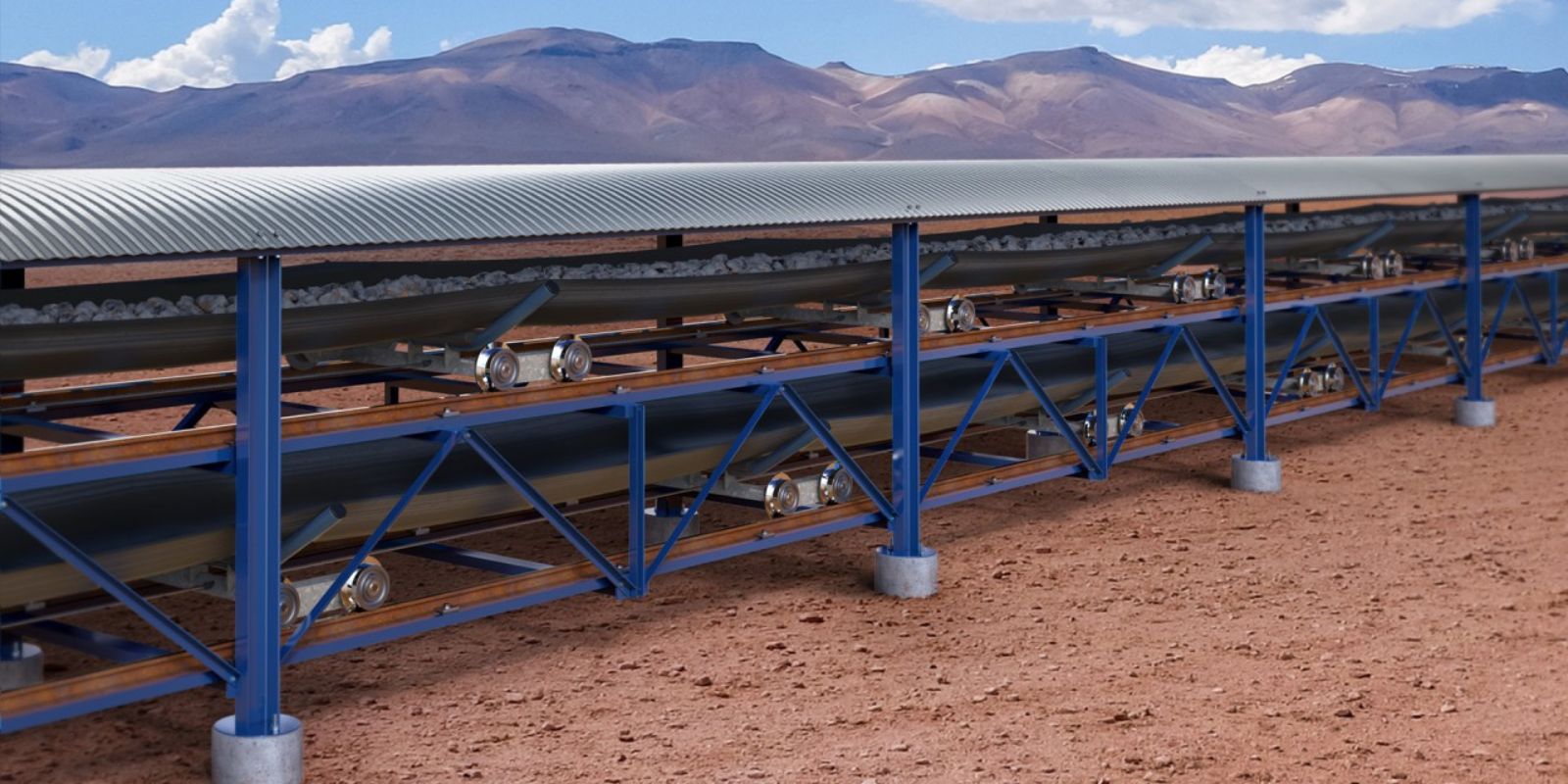
Overland conveyors lose much of their drive power to rolling resistance as the belt passes over idler rollers. In the Rail-Running Conveyor, the belt is carried on wheeled carts that run on rails. The belt can run as an open trough or as an enclosed pipe. Research and development studies show the system can use up to 50 per cent less energy for overland transport than a conventional conveyor.
- CBSPT researchers have contributed to its research and development for more than a decade, working with FLSmidth Mining Technologies.
- The first full-scale system, commissioned in Zambia, carries 5,000 tonnes of copper ore an hour and is estimated to save about $1 million a year in power.
- A second system has been designed to carry more than 13,000 tonnes of copper ore an hour, with an estimated power saving of $2 million a year.
- Fluor took over the technology licence in late 2025 through its subsidiary Virta Inc.
- In 2025 the team was awarded an ARC Linkage project on the friction, wear and fatigue of drive pulley lagging.
Source: Revolutionary conveyor system reduces energy use (University of Newcastle research impact)
Viper: vibration-assisted vacuum belt filtration
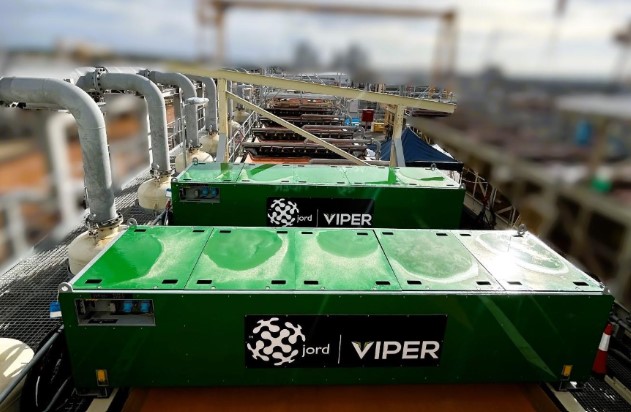
Horizontal vacuum belt filters remove water from fine ores, concentrates and tailings. CBSPT researchers developed and pilot-tested bolt-on improvements that add vibration energy to vacuum filtration to release more water from the filter cake. Jord International commercialised the resulting Viper system in 2020. It can be retrofitted to existing filters or supplied with new installations.
- Nearly 100 units have been sold to mining and mineral processing operations in Australia, the United States and Chile.
- Each filter can handle more than 10,000 tonnes of material a day, including magnetite, iron ore, gold and coal.
- Drier filter cake allows some sites to store tailings dry rather than in tailings dams.
- A new project with the Trailblazer for Recycling and Clean Energy (TRACE) is adapting the technology to recover critical minerals. A pilot plant was delivered to NIER in February 2026.
Source: Patented filtration technology adds value to minerals and mining sectors (University of Newcastle research impact)
Tailings to Topsoil
Coal mines produce large volumes of fine tailings that are usually stored in dams. Mine rehabilitation, meanwhile, is often short of topsoil. The Tailings to Topsoil project, led by Professor Kenneth Williams, is investigating whether suitable tailings can be turned into a soil additive, to help rehabilitate mined land and grow crops such as biomass for energy.
- The project was launched in 2018 through the Advanced METS Doctoral Training Centre, with Muswellbrook Shire Council, Bengalla Mining Company and Jord International as partners.
- It brings together CBSPT, the International Centre for Balanced Land Use and the Global Centre for Environmental Remediation.
- PhD research tested coal tailings from two Hunter Valley mine sites blended with native mine topsoil. It found that tailings could be used at low blend levels to help ease topsoil shortages at mine sites.
Sources: Research capabilities on show in the Upper Hunter (University of Newcastle, 2018); Bradney L (2023). Coal tailings for soil improvement. PhD thesis, University of Newcastle.
Conveyor belt rolling resistance testing
The energy a long conveyor uses depends largely on how the rubber belt cover deforms as it passes over each idler. CBSPT and TUNRA Bulk Solids developed an indentation rolling resistance (IRR) test method and test rig at NIER to measure this for different belt compounds.
- The method has been adopted as an Australian standard. It is one of two IRR tests recognised in the Conveyor Equipment Manufacturers Association (CEMA) design manual.
- In 2015 the facility was used in the design of a single-flight overland conveyor carrying 2,400 tonnes of coal an hour over 26.7 km to Sasol's Synfuels plant at Secunda, South Africa. At the time it was described as the world's longest single-flight belt conveyor.
Source: "Greener" belt conveying technology (University of Newcastle)
Safer shipping of iron ore fines
Bulk cargoes that hold too much moisture can liquefy and shift at sea. Cargo shifting of this kind has caused the loss of ships and crews. Through AMIRA International, the University of Newcastle, the University of Auckland and CSIRO worked with major Australian and Brazilian iron ore producers to systematically evaluate methods for measuring the transportable moisture limit (TML) of iron ore fines.
- The International Maritime Organization accepted a new TML test method for iron ore fines under the International Maritime Solid Bulk Cargoes (IMSBC) Code.
- Follow-on research modelled how iron ore cargoes become unstable in a ship's hold during a voyage.
Related publication: Chen W, Roberts A, Katterfeld A, Wheeler C (2018). Modelling the stability of iron ore bulk cargoes during marine transport. Powder Technology 326, 255–264.
Contact us

Enquiries
-
Danielle Harris
Phone: +61 2 4033 9039
Danielle.Harris@newcastle.edu.au
The University of Newcastle acknowledges the traditional custodians of the lands within our footprint areas: Awabakal, Darkinjung, Biripai, Worimi, Wonnarua, and Eora Nations. We also pay respect to the wisdom of our Elders past and present.